Why Transparent, Real-Time Reporting Is Reshaping Client Relationships in SEO
 shootupmedia1@gmail.com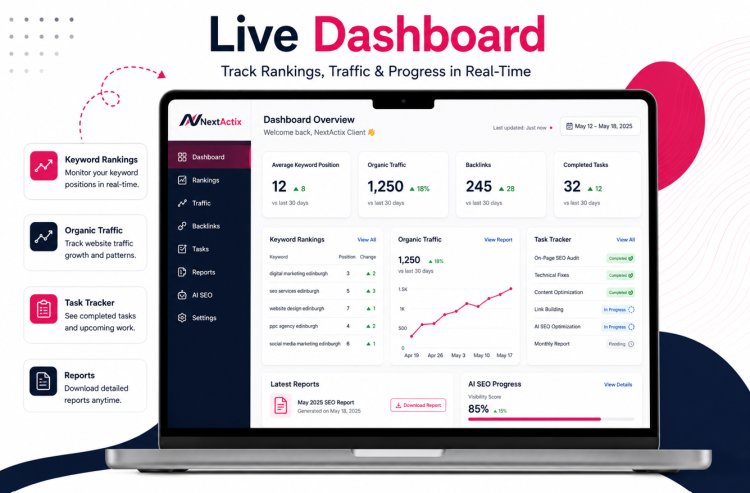
For years, the rhythm of working with an SEO or digital marketing agency followed the same pattern. Work happened somewhere in the background for four weeks, then a PDF landed in your inbox summarising what had been done. You'd skim the charts, ask a question or two on a call, and wait another month for the next instalment.
That rhythm is starting to feel out of step with how businesses actually operate.
Most business owners now check their bank balance, their ad spend and their website analytics in real time, often from a phone. Waiting thirty days to find out whether a technical fix actually worked, or whether a keyword moved after a content update, has started to feel less like patience and more like being kept in the dark.
What a live client dashboard actually is
A live client dashboard is a web-based interface, usually accessed through a login, that shows a client's marketing data as it changes rather than as a fixed snapshot taken once a month. Instead of receiving a static document that describes what happened between two dates, the client can log in at any point and see current keyword positions, recent backlinks, site health scores, and the status of tasks the agency is working on.
The difference from a traditional report isn't just the format. A PDF is a summary written after the fact, shaped by whoever compiled it. A dashboard is closer to a window into the actual account — the same data the agency itself is looking at, presented in a way a non-specialist can read without a call to interpret it.
That distinction matters more than it might sound. A monthly report can only ever answer questions the agency anticipated. A dashboard lets the client ask their own questions, on their own schedule — did that new page start ranking yet, did the backlink from last week actually go live, has site speed improved since the developer finished the fix.
Why the monthly PDF stopped being enough
None of this means monthly reporting was badly designed. It made sense when SEO tools themselves updated slowly and pulling data together took genuine manual effort. The report was, in effect, the only practical way to package weeks of scattered work into something a client could digest.
The problem is that SEO itself has sped up. Rankings shift weekly, sometimes daily. Technical issues can appear overnight after a site update and quietly cost a business visibility for weeks before the next report catches it. A month-old snapshot can hide exactly the kind of problem a client would want to know about immediately — a dropped page, a broken redirect, a sudden ranking loss after a Google update.
There's also a trust dimension. When a client only sees curated summaries chosen by the agency, it's reasonable for them to wonder what isn't being shown. That's not a comment on any particular agency's honesty — it's simply how information asymmetry works. A dashboard that shows the same data the agency sees removes that question by default, because there's nothing being pre-selected for presentation.
Transparency as a genuine differentiator
Ask business owners what frustrates them most about outsourced marketing, and a common answer isn't poor results — it's not knowing what's actually happening. A campaign can be performing reasonably well and still feel opaque if the only communication is a call once a month and a document full of unfamiliar metrics.
That's part of why transparency has become something businesses actively evaluate when choosing who to work with, rather than an assumed baseline. It's a fair question to ask a prospective agency: can I see my own data whenever I want, or only when you decide to send it to me. Increasingly, the answer to that question shapes the decision as much as price or case studies do — and it's a question being asked as often in fast-moving markets like Dubai SEO Services as it is anywhere else, where competition for visibility is dense and clients are used to a certain pace of communication.
Practically, this shows up in a few areas that matter to most businesses running SEO or a broader digital marketing programme:
Keyword tracking that updates continuously, rather than being pulled together once a month, lets a business owner see the effect of a content change within days instead of weeks. Backlink monitoring works the same way — new links, and just as importantly lost ones, are far more useful to know about as they happen than in a retrospective list. Technical SEO monitoring, covering things like site speed, broken pages, or crawl errors, catches problems while they're still small. And task tracking — simply being able to see what the agency is currently working on, and what's queued next — replaces a surprising amount of the back-and-forth email traffic that eats into both sides' time.
A Dubai example: what transparency actually solves
It's worth making this concrete with a market where the stakes of visibility are especially high. Take a real estate agency operating in Dubai, listing properties across several developments and competing against dozens of other agencies for the same searches. Property listings change weekly. New developments launch. A page that ranked well for a particular community last month can lose ground within days if a competitor publishes fresher, more detailed content first.
For an agency in that position, working with Dubai SEO Services on a monthly reporting cycle means finding out about a ranking drop, a lost backlink, or a technical issue on a listings page roughly four weeks after it happened — often after a chunk of that month's search visibility has already gone. A live dashboard changes that timeline. The marketing manager can see, the same week a new development launches, whether the corresponding landing page is being indexed and picked up in search. They can see whether a competitor's link-building push has pulled ahead in the rankings for a specific area, rather than reading about it after the fact. And because Dubai's property market moves on tight seasonal cycles, being able to check progress against a listing deadline, rather than waiting for a scheduled report, often matters more than the report itself.
None of this is about revenue or guaranteed placements — it's simply about a business being able to see, at any point, whether the work behind its visibility is actually happening.
Why real-time visibility matters for real estate marketing specifically
Property is one of the clearer cases for why real-time reporting has become more useful than the monthly alternative. SEO for Real Estate Agency campaigns tends to involve more moving parts than most other sectors — local keyword monitoring across multiple neighbourhoods or developments, a Google Business Profile that needs to reflect current listings and contact details accurately, ongoing technical SEO work as new property pages are added and old ones retired, and landing pages that are frequently updated with new imagery, pricing and availability.
Each of those elements changes on its own schedule, which makes a single monthly snapshot a poor fit. A landing page updated on a Tuesday shouldn't need four weeks before anyone finds out whether it's performing. Lead generation monitoring benefits from the same logic — an agency wants to know quickly if a new campaign or page is converting enquiries, not find out at the end of the month that a slow week went unnoticed. Increasingly, this also extends to AI search visibility: whether a property page is being picked up and cited when a prospective buyer asks an AI tool to compare developments or neighbourhoods, rather than only tracking where it sits in a traditional set of search results.
Reporting on all of this after the fact tells an agency what happened. Reporting on it in real time gives them the chance to act while it still matters.
Faster decisions, not just more information
There's a practical business case here beyond trust. When a client can see live data, they can make decisions faster. A retailer preparing for a seasonal campaign doesn't need to wait for a monthly call to know whether their top category pages are ranking in time — they can check. A business considering a site redesign can see, in real time, whether a recent technical change helped or hurt performance, rather than finding out a month later when it's harder to reverse.
Downloadable reports still have a place in this picture. Board meetings, investor updates and quarterly reviews still call for a clean, exportable document. The shift isn't away from reports entirely — it's toward giving clients the choice of when they want a report versus when they simply want to look something up themselves.
Where this fits into AI-powered search
Transparent reporting matters for another reason that's becoming harder to ignore. As more customer discovery moves through AI-generated answers rather than traditional search listings, the metrics that matter to a business are changing too — not just rankings, but whether a business is being cited, how consistent its information is across the web, and how quickly technical issues are caught and fixed. A live dashboard that only shows last month's keyword positions misses a lot of that picture. One built to track AI SEO progress alongside traditional rankings gives a more honest read of where a business actually stands.
Reporting itself is quietly becoming part of the customer experience an agency offers, rather than an administrative task that happens after the real work is done. A client who can check their own account whenever a question occurs to them is having a fundamentally different relationship with their agency than one who has to wait for a scheduled call to ask it.
How NextActix approached this
This is the thinking behind NextActix's Live Client Dashboard, built for clients using its SEO, technical SEO, content strategy, link building, Dubai SEO Services and AI search optimisation services, including agencies running SEO for Real Estate Agency campaigns across the UAE. Rather than functioning as a reporting add-on, it was designed around the idea that clients should be able to see the actual state of their account — completed SEO tasks, keyword rankings, backlink progress, website improvements and AI SEO progress — at any point, with a downloadable report available whenever they need one for a meeting or a record.
"Businesses shouldn't have to wait until the end of the month to understand what's happening with their marketing," said a NextActix spokesperson. "Transparency builds stronger partnerships, and that's exactly what we wanted our dashboard to deliver."
Reporting, in that sense, is starting to do more than justify past work. It's becoming one of the few consistent ways an agency shows a client what its judgement actually looks like in practice, week after week, rather than only once a month.
Where reporting goes from here
The monthly PDF isn't going to disappear overnight, and for some purposes it still serves a purpose. But the direction of travel is clear. Businesses increasingly expect the same real-time visibility into their marketing that they already have into their sales, their advertising spend, and their finances. Agencies that treat reporting as something clients wait for, rather than something clients can check whenever they need to, are working against that expectation rather than with it.
The agencies that adapt well won't be the ones with the flashiest dashboard design. They'll be the ones willing to let clients see the same picture they see themselves.